

Owners often arrive with a programme in mind. They have read about obedience, behaviour work, protection, detection, or residential training and want to know how soon it can begin. The responsible answer starts with the dog in front of us.
Temperament assessment is not a quiz with a universal score. It is a structured observation of behaviour across relevant situations, interpreted alongside the dog’s age, health, history, environment, and handling. A single session can be useful, but it is still a sample. Where the stakes are high or the picture is unclear, the judgement should remain provisional until more evidence is seen.
We begin with ordinary behaviour. How does the dog enter a new place? Does it explore, freeze, avoid, rush forward, or look to the handler? Can it take food, respond to a familiar cue, and move through the environment without becoming fixed on one stimulus? None of these observations is decisive alone. The pattern is what matters.
Novelty and mild pressure reveal another part of the picture. We watch the first response and the recovery that follows. A startle is normal. The useful question is whether the dog can process the event, return to baseline, and remain available to guidance. We also observe frustration, restraint, valued objects, social contact, movement, sound, and thresholds where these are relevant and safe to assess.
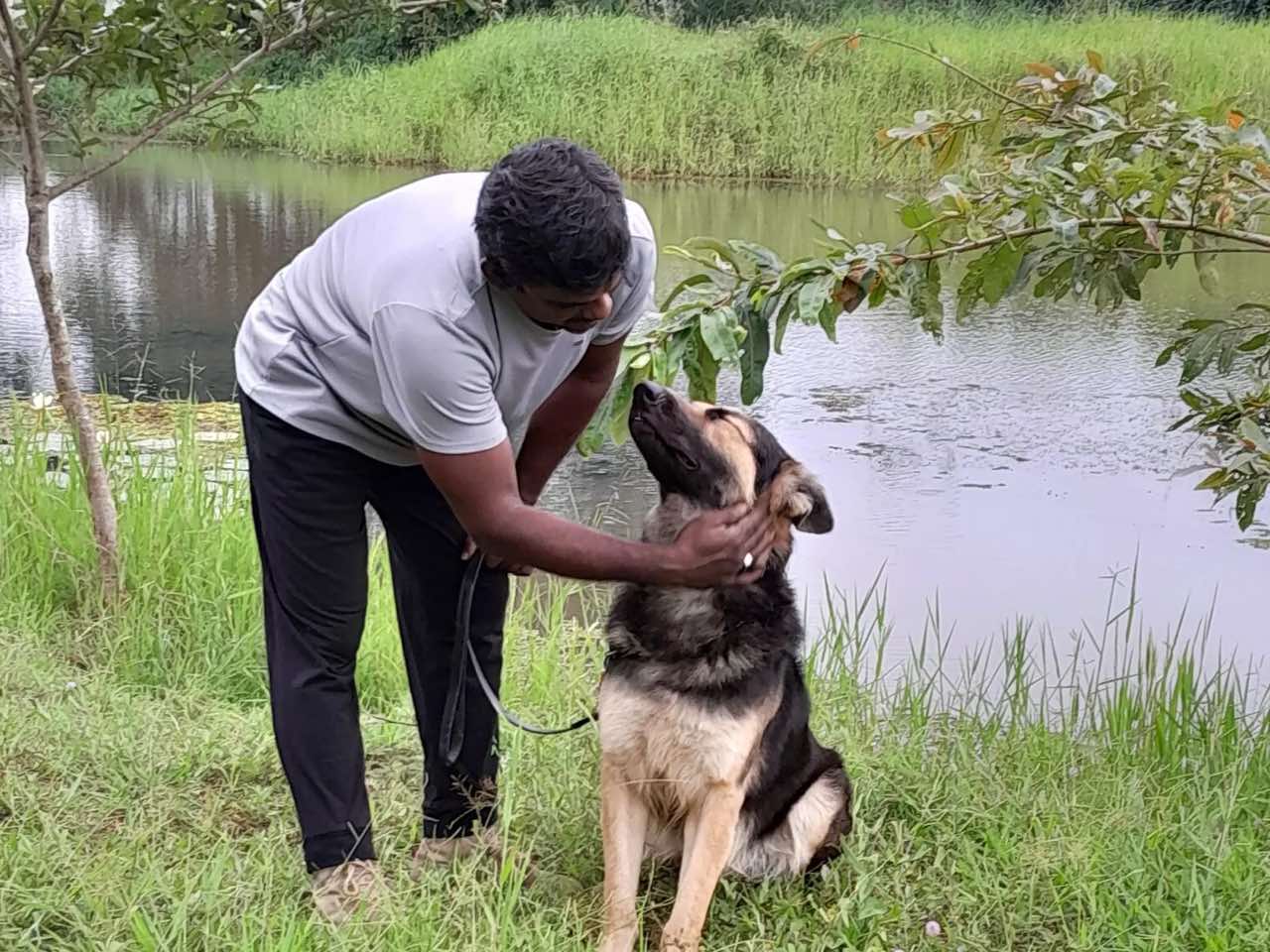
Handler orientation deserves close attention. Some dogs naturally check back with a person when uncertain. Others try to solve the environment alone. Both can learn, but they may need different foundations. The handler’s own timing, clarity, and emotional state also influence what appears during assessment, so the dog should not be judged as if it exists outside that relationship.
Confidence can be over-read. A dog that enters boldly may be genuinely stable, poorly inhibited, highly aroused, or simply untested. A quiet dog may be calm, shut down, cautious, tired, or in discomfort. Labels applied too early make the rest of the assessment less reliable because the observer starts collecting evidence for a conclusion already made.
The programme follows from the complete picture. One dog may need household structure and owner coaching. Another may require behaviour support with veterinary involvement. A suitable working prospect may proceed to role-specific testing. A dog proposed for protection may be redirected to ordinary obedience because the required stability or recovery is not present.
The same restraint applies to refusal. Saying that a dog is unsuitable for a particular role is not a judgment on its worth. It is an attempt to keep the dog out of work that could create distress, conflict, or risk.
Assessment is valuable because it changes the order of decision-making. The dog is read first. The programme is named afterwards, if a programme is appropriate at all.
Temperament assessment is not a quiz with a universal score. It is a structured observation of behaviour across relevant situations, interpreted alongside the dog’s age, health, history, environment, and handling. A single session can be useful, but it is still a sample. Where the stakes are high or the picture is unclear, the judgement should remain provisional until more evidence is seen.
We begin with ordinary behaviour. How does the dog enter a new place? Does it explore, freeze, avoid, rush forward, or look to the handler? Can it take food, respond to a familiar cue, and move through the environment without becoming fixed on one stimulus? None of these observations is decisive alone. The pattern is what matters.
Novelty and mild pressure reveal another part of the picture. We watch the first response and the recovery that follows. A startle is normal. The useful question is whether the dog can process the event, return to baseline, and remain available to guidance. We also observe frustration, restraint, valued objects, social contact, movement, sound, and thresholds where these are relevant and safe to assess.
Handler orientation deserves close attention. Some dogs naturally check back with a person when uncertain. Others try to solve the environment alone. Both can learn, but they may need different foundations. The handler’s own timing, clarity, and emotional state also influence what appears during assessment, so the dog should not be judged as if it exists outside that relationship.
Confidence can be over-read. A dog that enters boldly may be genuinely stable, poorly inhibited, highly aroused, or simply untested. A quiet dog may be calm, shut down, cautious, tired, or in discomfort. Labels applied too early make the rest of the assessment less reliable because the observer starts collecting evidence for a conclusion already made.
The programme follows from the complete picture. One dog may need household structure and owner coaching. Another may require behaviour support with veterinary involvement. A suitable working prospect may proceed to role-specific testing. A dog proposed for protection may be redirected to ordinary obedience because the required stability or recovery is not present.
The same restraint applies to refusal. Saying that a dog is unsuitable for a particular role is not a judgment on its worth. It is an attempt to keep the dog out of work that could create distress, conflict, or risk.
Assessment is valuable because it changes the order of decision-making. The dog is read first. The programme is named afterwards, if a programme is appropriate at all.